


Climate Leader
The Climate Leader program is a voluntary initiative administered by the Massachusetts Department of Energy Resources (DOER). It evolved from the Green Communities program, which focused primarily on energy efficiency and reducing energy consumption. Building on those efforts, the Climate Leader program helps municipalities reduce greenhouse gas emissions.
The program provides a framework, technical support, and grant funding to help cities and towns transition to cleaner energy systems. Communities work toward goals such as electrifying municipal buildings and vehicles, improving building envelops, and supporting renewable energy projects.
Medway was among the initial cohorts of municipalities to be designated a Green Community back in 2010, and pursuing Climate Leader designation is the next step to help the Town meet its environmental goals.
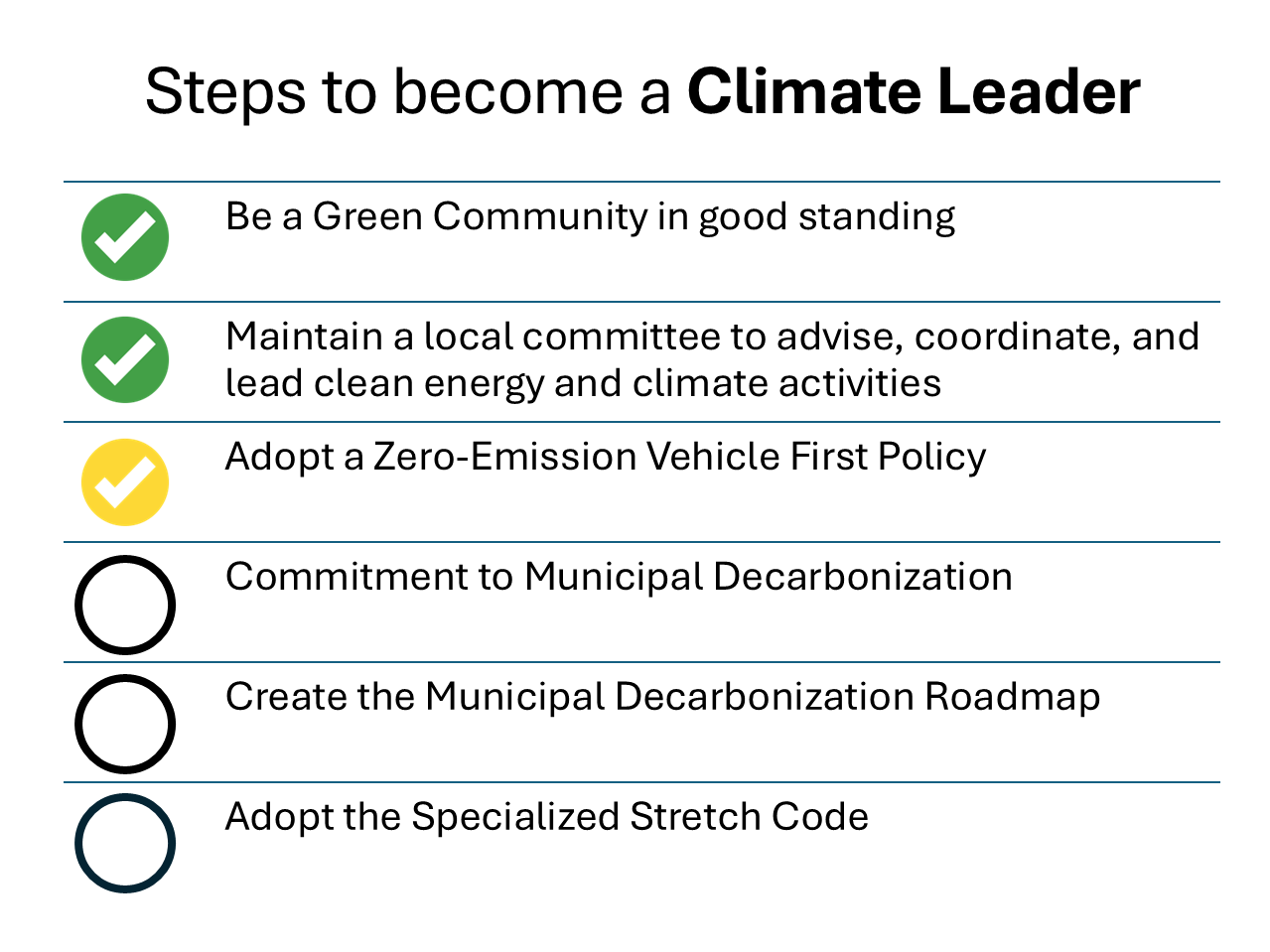
There are six requirements the Town must meet in order to become a Climate Leader. We have met two of these requirements, and are working towards the others. As the Town did with the adoption of the Stretch Code in 2010, the Town must adopt the Specialized Code via Town Meeting.
- The Specialized Code applies to new construction only.
- It does not apply to renovations, additions or historic buildings.
- The Specialized Code facilitates, but does not require,the electrification of new buildings.
- Multiple pathways to compliance are available (including mixed fuels).
- Opportunity for additional state funding
- DOER's program will give additional funding/privileges to communities that have adopted the Specialized Code and become “Climate Leaders”. More information about the program.
1. Pre-wiring for future electrification
- Mixed-fuel buildings (using fossil fuels) must prewire for future electrification, providing consumer protection.
2. Solar panels for buildings using mixed fuels
Mixed-fuel buildings must install solar (with exemptions)
3. Exemplary performance for large homes
Homes larger than 4,000 conditioned square feet must be all-electric or zero energy
4. Exemplary performance for large multifamily
Multifamily buildings over 12,000 conditioned square feet must use the Passive House pathway.
What are the energy code options for Massachusetts municipalities?
Cities and towns have three choices of standards for building energy performance: (1) a required Base Energy Code, (2) an optional, more energy efficient Stretch Energy Code, and (3) a new opt-in Specialized Energy Code that was created to ensure new construction meets State greenhouse gas limits.
What energy code currently applies in Medway?
Medway adopted the Stretch Code in 2010, effective July 1, 2011.
What is the Specialized Code?
The Specialized code is required by statute (MGL 25A Section 6) to help achieve MA GHG emission limits and building sector sub-limits set every five years from 2025 to 2050. As a result, all compliance pathways under the Specialized code are designed to ensure new construction that is consistent with a net-zero Massachusetts economy in 2050, primarily through a combination of energy efficiency, that it in turn enables reduced heating loads, and efficient electrification. Use of fossil fuels such as gas and propane or biomass is permitted but comes with additional requirements for on-site solar generation and pre-wiring for future electrification of any fossil fuel using equipment.
How is the Specialized Code different from the Stretch Code?
Under the Specialized Code, all mixed-fuel residential and commercial buildings (i.e. with any space or water heating or appliances powered by fossil fuels) must provide pre-wiring for electric space heating, electric water heating, and electric appliances. Mixed-fuel buildings must also install solar. New homes greater than 4,000 square feet must install enough solar to result in a net-zero energy consumption.
Multi-family residential buildings greater than 12,000 square must be built to the highly energy efficient Passive House standard.
Mixed-fuel Commercial and Municipal buildings of all sizes must offset their emissions by providing on-site solar arrays or achieve the Passive House standard and pre-wiring for future electrification.
What are the cost implications of the Specialized Code on Medway residents?
There are no cost implications for Medway residents because this code only applies to new construction. Any renovations or additions would fall under the Stretch Code.
What are the anticipated costs of building under the Specialized Code verses the Stretch Code?
DOER has commissioned studies to analyze the change in construction costs related to building to the Stretch code for several sizes and types of residences, and they generally indicate the construction and operating costs are lower with fully electric heating and cooling via heat pumps compared to fossil fuels. https://www.mass.gov/doc/residential-Stretch-code-costs-and-benefits-case-studies/download
Under the Specialized Energy Code, there would be no additional costs for all-electric buildings compared to the Stretch Code.
Under the Specialized Energy Code, anticipated additional costs for new mixed-fuel buildings include the cost to pre-wire the building for future electrification and the cost to install solar, which will vary by project size.
Adopting the Specialized Code would increase incentives for builders to install all-electric heating and appliances in new construction, thereby protecting future owners and tenants from the high cost of transitioning a building from fossil fuels to all-electric later.
What is the Passive House Standard?
Passive house is a building design and construction standard focused on high-performance enclosures that dramatically reduce energy use.
Benefits of Passive House
- Healthier, because ventilation and filtering keep the air inside clean and fresh
- More comfortable, because of better noise, moisture, odor control
- More resilient, because they can maintain safe temperatures for days without power
- Cheaper to run, because you can cut heating energy use by up to 90%
- Better for the environment, because lower energy use means lower emissions
- Better for the grid, because of lower peak demand
- Electrifying without the Specialized (or to a lesser extent the Stretch Code) risks substantially increased electrical loads during peak demand
- Passive house buildings can also be all-electric or mixed fuel
- Verified by independent 3rd parties, so building officials don’t require new training
- Low upfront cost premium, especially for large buildings, only 1-3% more than traditional
- Increased cost design and material costs largely offset by lower cost for HVAC

Committee Members
Chair
Martin Dietrich
Vice Chair
Wallace Long
Member
Jason Reposa
Member
Dave Travalini
Member
Alex Gutkowski
Staff Contact
Sustainability Coordinator
Stephanie Carlisle
Phone: (508) 533-3275
Mission Statement
The Medway Energy and Sustainability Committee is charged with investigating, studying, recommending, and advocating viable methods for achieving energy conservation, using renewable sources of energy, and for promoting sustainability within the Town and Medway community.
The following is included in our vision:
The Medway Energy and Sustainability Committee strives to be a model of environmental stewardship by investigating, studying, recommending, and advocating sustainable solutions into our community through renewable energy, water conservation, and environmentally conscious solutions within the town and Medway community. The Committee works with municipal departments, businesses, institutions, and civic and volunteer organizations to initiate and carry out actions to achieve emissions reductions and other sustainability initiatives.
This includes:
- Establishing energy inventories for the Town and setting goals for energy reductions.
- Assessing the scope of energy conservation and renewable energy use in Town buildings and vehicles.
- Recommending feasible projects for sustainability, energy and water conservation, and renewable energy use.
- Reviewing Town by-laws to promote sustainability, energy and water conservation, and renewable energy use.
- Educating and providing outreach to Medway citizens.
- Coordinating with various state, federal, and private agencies on sustainability, energy and renewable issues.
- Advise and assist the Town and community to identify and apply for sustainability, energy and conservation related grants and funding opportunities.
Energy Efficiency 101 - Heat Pump Myth Busting
Energy Efficiency 101 - Weatherization Basics
Energy Efficiency 101 - Home Energy Assessments
Community Choice Aggregation Program
Green Communities - Energy Evaluation
Green Communities - Stretch Code
MA Clean Energy Center - Main Page
MA Clean Energy Center - Clean Energy Lives Here
MA Department of Energy Resources (DOER)
RECYCLOPEDIA - Can I recycle it?
Residential Guide to Solar Power
Solar Array - McGovern Elementary School
Value of Nature Facts - Mass Audubon
Video/Webinar - Emerging Clean Energy Technology
Video/Webinar - The Impervious Problem
Subscribe to our seasonal Newsletter to learn about sustainability initiatives in Medway!